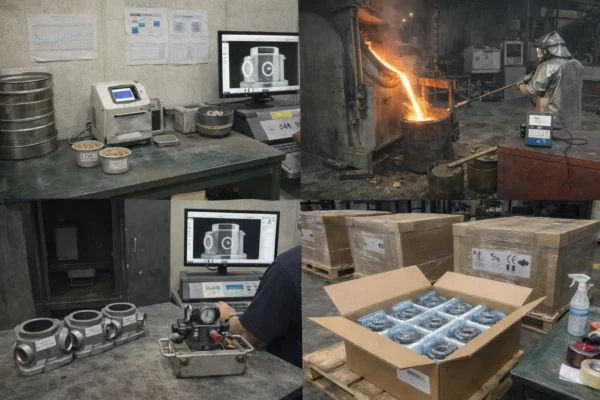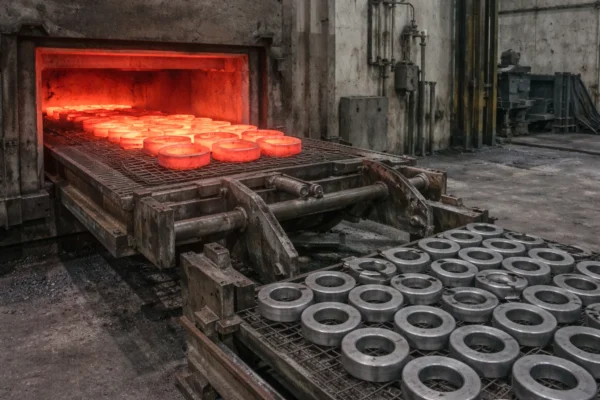
I see buyers wrestle with late shipments, rework costs, and unpredictable scrap. Lost foam fixes many pains when set up right.
Lost-foam casting uses an expendable EPS foam pattern with a refractory coating, supported by dry sand; molten metal replaces the foam, giving near-net, zero-draft parts with fewer cores and less machining.

I write this from a buyer’s view and a factory floor view. I show what I control, where money hides, and how to avoid carbon pickup and burn-on. If you need immediate support, jump to Contact, browse Casting Parts, or scan CNC Parts. You can also learn material trade-offs in Selecting the Right Alloy for Metal Casting and my buyer playbook OEM Metal Casting: What Engineers Must Know.
Step-by-Step Process (Foam Pattern → Sand Mold → Metal Pour)?
Rushing the basics kills yield. Skip density, coat, or vibration, and the fill turns violent, gas traps, and finish suffers.
Make the EPS pattern; apply a porous refractory and dry to stable weight; compact dry sand under staged vibration; use light vacuum if needed; pour at a tight temperature window for laminar fill and clean gas escape.
I begin with the pattern and lock density for the wall and alloy. I like 18–24 g/L for thin-wall aluminum and iron. That range keeps the pattern stiff during vibration but does not overload the front with gas. I integrate runners into the foam so velocity stays smooth. I record cluster weights for yield and repeatability. I treat the coating as a breathing membrane, not paint. I dry to a weight plateau, not a timer. I use clean, dry, unbonded sand and staged vibration so the pattern is supported without crush. I pour with a steady head and avoid splash. When the front is laminar, the pour sounds calm. For drawing setup and machining stock, I map tolerances to ISO 8062-3 so our PPAP files match a global baseline, and I keep training aligned with the AFS Lost Foam Division.

Process window at a glance
| Stage | What I control | Typical target | What goes wrong | My fix |
|---|---|---|---|---|
| EPS pattern | Density, geometry, gating | 18–24 g/L for thin walls | Denting, high gas | Add ribs; tune density |
| Coating | Permeability & thickness | Even film; alloy-matched | Burn-on, penetration | Tune solids/viscosity; test cups |
| Drying | Moisture state | Weight plateau | Gas trapped | Extend dry time; airflow |
| Sand & vibration | Compaction profile | Short bursts + rest | Crush, warp | Probe density; local supports |
| Vacuum assist | inHg level | Light, steady | Sand shift, defects | Reduce level; move vents |
| Pouring | Temp & head | Narrow window | Misrun, carbon pickup | Tight temp; avoid splash |

Expanded step map with roles and checks
| Process step | Owner | Measured input | Go/No-Go check | Record kept |
|---|---|---|---|---|
| EPS pre-expand | Molding tech | Bead bulk density | Spec range met | Batch ID, density |
| Foam molding | Tooling cell | Mold temp, cycle time | Pattern weight ± tol. | Weigh sheet, cavity count |
| Cluster build | Assembly | Runner lengths, joints | Jig stops fit | Cluster weight log |
| Coating | Coating line | Viscosity, solids | Even film | Lot, viscosity log |
| Drying | Coating line | Time, airflow | Weight plateau | Start/stop times |
| Sand fill | Molding | Vib profile | Density probes | Probe readings |
| Vacuum assist | Molding | inHg | Stable level | Level vs time |
| Pour | Melt bay | Temp, ladle ID | Window hit | Pour card |
| Knockout | Post-pour | Flask ID | Free-flow sand | Scrap tag if any |
| Finish & QC | Finishing/Metrology | Cut-off weight, CMM | CTQs pass | Full report |
Foam density selection guide (plain rules)
| Geometry & alloy | Wall | Density pick | Why |
|---|---|---|---|
| Thin-wall Al-Si manifold | 2.5–4.0 mm | 20–24 g/L | Stiff under vibration |
| Mid-wall gray iron housing | 4–6 mm | 18–22 g/L | Balanced gas evolution |
| Thick ductile iron yoke | 8–12 mm | 16–18 g/L | Lower gas load |
| Tall slender ribs | ≤4 mm, height>4×t | 22–24 g/L | Buckling resistance |
| Large panel areas | ≥5 mm | 18–20 g/L | Dimensional stability |
If you want a quick review before tooling, send CAD through Contact, reference ISO 8062-3 on your drawings, and note wall targets and leak tests. See also our internal guides: Alloy selection and OEM Metal Casting primer.
Advantages vs Sand/Investment Casting?
Buyers ask if lost foam beats every process. It does not. But it wins in the right box: complex shapes, thin walls, zero draft, and core elimination.
Lost foam outperforms green sand when draft and cores dominate cost; it outperforms investment casting on larger thin-wall aluminum and iron where shell cycles and per-piece cost climb.
I use a simple scorecard. I judge geometry freedom, cost at volume, lead time, surface, tolerance, and risk. I share it early so we do not fight the wrong process. I show machining minutes saved. I show yield. I show scrap. If investment casting or green sand is a better fit, I say it on day one and still quote the right route. You can browse Casting Parts and send one contact request for both options.
Quick score table (buyer view)
| Criterion | Lost Foam | Green Sand | Investment Casting |
|---|---|---|---|
| Draft on external faces | Not required (often zero) | Required | Not required |
| Cores for hollow features | Often eliminated | Common and numerous | Ceramic cores or soluble wax |
| Thin walls | Strong for Al/Fe with tuned window | Moderate | Excellent, but size-limited |
| Surface finish (Ra) | Good with tuned coat | Fair without post-finish | Excellent |
| Tolerance potential | Good with pattern control | Moderate | Excellent |
| Part size sweet spot | Small → very large | Small → very large | Small → medium |
| Lead time to first parts | Fast once tooled | Fast if simple | Slower (shell cycles) |
| Tooling cost | Medium | Low–medium | Medium–high |
| Cost at volume | Low for complex shapes | Low for simple shapes | Higher above mid sizes |
| Best use case | Consolidated, zero-draft geometry | Simple prismatic castings | Small, high-precision alloys |
What I actually see on the floor
- We convert five-core manifolds from green sand to one lost-foam casting with built-in passages. Machining drops 30–50% because faces start flat and draft goes to zero.
- Investment wins when a part is small, cosmetic, and ultra-tight. Lost foam wins when size grows and thin walls meet cost pressure.
- When a buyer cares about leak paths, consolidation pays twice: fewer joints, fewer gaskets.
Applications (Automotive Blocks, Manifolds, Marine)?
Lost foam fits parts that get messy in traditional tooling: deep passages, tight envelopes, and many add-on bosses.
Engine blocks and heads, intake and exhaust manifolds, and marine housings are proven spaces. Lost foam supports consolidated passages, zero-draft faces, and thin walls at larger sizes with repeatable stability.
Automotive engine blocks and heads
Blocks love consolidation. Water jackets, oil galleries, and bosses crowd the design. Green sand stacks cores; every core adds risk. Lost foam trades those cores for one foam geometry that carries voids in place. I keep deck faces stable with uniform sand support. I balance gates so bores fill evenly. I match iron chemistry, temperature, and coat permeability to avoid carbon pickup. For auto launches I run APQP + PPAP L3: CP-FMEA, control plan, MSA, capability (Cpk/Ppk), and PSW sign-off. If you want examples, ping us through Contact and ask for an anonymized PPAP pack.
Manifolds and complex air paths
Intake and exhaust manifolds punish turbulence. Lost foam lets me create smooth turns and big merge radii. I cast bosses for O-sensor and EGR directly on the pattern. I keep flange faces zero-draft to cut surfacing time. When sections change fast, I add chills and tune coat permeability to stop burn-on. If you are still weighing materials, this in-house guide helps: Selecting the Right Alloy.
Marine housings and brackets
Marine housings need paint-ready surfaces and light but stiff walls. For mid volume, I hard-tool EPS. For low volume, I machine EPS or 3D-print patterns until the design freezes. To survive salt routes, I pack in VCI with corner protectors and strap pallets tight for export. See our general capabilities on Product and then send dimensions via Contact.
Typical parts and quick guide
| Part type | Typical alloy | Wall thickness | Size range | Volume band | Why lost foam fits |
|---|---|---|---|---|---|
| Engine block | Gray or ductile iron | 3–6 mm (thicker mains) | Medium → large | Medium → high | Consolidate cores, zero-draft faces |
| Intake manifold | Al-Si | 2.5–4 mm | Small → medium | Medium → high | Smooth flow, weight cut |
| Exhaust manifold | SiMo iron | 4–6 mm | Small → medium | Medium | Thermal stability, smooth merges |
| Marine pump housing | Al-Mg / Al-Si | 3–5 mm | Small → medium | Low → medium | Paintable surface, net bosses |
| Marine bracket | Al-Si | 4–8 mm | Small → large | Low → medium | Replace weldments, tight fit |
Cost Drivers (Pattern Making, Volume, Alloy Type)?
Quotes swing when people ignore three drivers: pattern tooling and cluster yield, volume and learning, and alloy + process window.
Iron blocks repay tooling fast. Low-volume marine housings often prefer CNC-cut or 3D-printed foam patterns until geometry stabilizes. Yield and machining minutes make or break the piece price.
Pattern making and tooling
| Route | When I choose it | Per-pattern cost | Notes |
|---|---|---|---|
| Molded EPS (aluminum die) | Mid/high volume; stable design | Low | Upfront tool; fast cycles |
| CNC-cut EPS billet | Prototyping; low volume | Medium–high | No tool; flexible |
| 3D-printed pattern | Complex geometry trials | High | Fast design loops |
What drives pattern cost? tool complexity, tolerance, cluster design, and change rate. If your design may move, start with CNC or print. Freeze geometry. Then hard-tool. For deeper reading from our team, scan How to select a precision casting supplier.
Cluster yield and gating (money lever)
Yield = part weight ÷ poured weight.
Example: 12.0 kg part; first cut-offs 6.0 kg → 66.7% yield.
Improve gating; cut-offs 4.5 kg → 72.7% yield.
That six-point gain lowers metal and energy, and it shortens saw time.
Volume, learning, and break-even
- Foam tool: \$45,000
- CNC pattern: \$120/part if no tool
- 5,000 parts/year → \$45,000 / 5,000 = \$9 saved per part from tooling alone.
At 200 parts, amortization becomes \$225/part, so I stay with CNC/printed patterns until volume justifies a die. I document the choice in PPAP so finance and QA see the logic.
Alloy type and process window (risk lever)
| Alloy | Risk | Control I use |
|---|---|---|
| Al-Si (A356 etc.) | Metal penetration if coat too open | Tune coat; ~700–740 °C pour; steady head |
| Gray iron | Carbon pickup; burn-on | Narrow superheat; coat perm match; light vacuum |
| Ductile iron | Nodularity loss if gas traps | Full drying; laminar gating; micro checks |
| SiMo iron | Hot tear in transitions | Radii, chills, controlled cooling |
If you need machining in one flow, our CNC Parts team sits next to finishing so fixtures line up with casting datums. If you want industry context by material, see Alloy selection.
Transparent cost breakdown template
| Cost element | Typical unit | Example value | Notes |
|---|---|---|---|
| Tooling (foam die) | \$ | 45,000 | One-time; amortized |
| Pattern per part | \$/part | 6.00 | Molded EPS; CNC ~\$120 |
| Cluster assembly | \$/part | 2.50 | Glue, sprue, QC |
| Coating & drying | \$/part | 1.80 | Refractory + energy |
| Sand handling | \$/part | 1.20 | Fill, vibrate, reclaim |
| Pouring & melt | \$/kg poured | 2.20 | Metal + energy |
| Poured weight | kg/part | 16.5 | For a 12.0 kg part @72.7% |
| Finishing | \$/part | 4.00 | Cut-off, light grind |
| Machining | \$/part | 9.50 | Often 30–50% less vs green sand |
| Scrap allowance | % | 4% | On variable costs |
| QC & test | \$/part | 1.50 | Leak, hardness, NDT |
| Packaging | \$/part | 1.20 | Export-grade, foam liners |
| Logistics | \$/part | 3.00 | To port or DDP, variable |
RFQ checklist that gets you a fast, clean quote
| Data I need | Why it matters | Format |
|---|---|---|
| CAD (STEP) | Pattern + stock planning | 3D + 2D |
| Material spec | Melt practice | ASTM/EN grade |
| Annual volume | Tooling ROI | Units/year |
| Batch size | Melt scheduling | Pieces/run |
| CTQs & tolerances | Process window | Marked drawing |
| Surface finish target | Coating choice | Ra/visual |
| Leak test needs | Test plan | kPa/bar + time |
| NDT needs | Cost/time | X-ray/UT/DP |
| Machining map | Stock and fixturing | Datum scheme |
| Packaging spec | Damage control | Carton/tray |
| Incoterms | Logistics | EXW/FOB/DDP |
| Payment | Cash planning | T/T, LC |
When you are ready, submit files via Contact and reference any internal article you want us to follow, like OEM Metal Casting.
FAQs — Lost Foam Casting (long-tail buyer questions answered)?
Buyers type very specific questions into Google. I answer them here in plain words and from my factory experience.
These FAQs cover density, coating permeability, vacuum assist, thin-wall limits, tolerances, tooling, PPAP, leak tests, packaging, and supplier selection.

What is lost foam casting in simple terms?
I make a foam pattern, coat it, bury it in dry sand, and pour metal. The foam vaporizes and metal takes its place. The result is near-net shape with no parting line. For background, see the AFS Lost Foam Division and the ASM Lost Foam Casting chapter.
How does lost foam differ from investment casting?
Investment uses wax and ceramic shells. It shines on smaller, high-precision parts with premium surfaces. Lost foam uses EPS and unbonded sand and often wins on bigger, complex shapes with thin walls and fewer cores. A quick overview sits here: investment casting.
What foam density do you use?
For thin walls I set 18–24 g/L. For thick iron I drop a bit to reduce gas load. For tall slender features I go higher for stiffness. We prove the pick with sample clusters before we lock tooling.
Why is coating permeability important?
The coat must vent pyrolysis gases and block sand. Too tight traps gas; too open allows penetration. I tune solids, viscosity, and thickness by alloy and wall.
Do you use vacuum assist?
Yes, when geometry or alloy needs it. Light, steady vacuum lowers pressure at the front and helps laminar fill. Too much can disturb sand, so I cap the level.
What wall thickness can you cast?
Aluminum: ~2.5–3.0 mm in stable zones. Gray iron: ~3–4 mm with care. I keep sections uniform and use generous radii. These are workable targets when the process window is tight.
What tolerances can I expect?
On tuned programs: ±0.5–1.0 mm per 100 mm and 0.2–0.5 mm/100 mm flatness on supported faces. I still machine datums and seal faces. We align drawings to ISO 8062-3 classes and call stock only where needed.
How much machining can lost foam save?
On manifolds and housings, I often cut 30–50% of machining minutes vs green sand through consolidation and zero-draft faces. We verify with time studies in our finishing + CNC Parts cell.
What pouring temperatures do you use?
For A356 aluminum, ~700–740 °C works well when the coat breathes and the head is steady. For iron, I lock a narrow window by section and grade. We track melt cards by ladle.
Do you provide PPAP?
Yes. I submit PPAP Level 3 with PSW, CP-FMEA, MSA, capability, and dimensional reports. I support FAIR-style packs when requested.
Do you pressure-test parts?
Yes. I run air-under-water or hydro at your pressure and duration, tag pass/fail, and store results. Leak requirements sit in the control plan and PPAP.
How do you package parts for export?
VCI bags, trays, corner protectors, strong cartons, strapped pallets, QR labels. If you ship by sea, I add desiccant and wrap to spec.
Can you integrate multiple parts into one casting?
Yes. Consolidation is a core win. I merge brackets, bosses, and passages into one casting. That saves machining and assembly and cuts leak points.
What is the MOQ and lead time?
No hard MOQ. Pilot lots of 50–100 via CNC/printed patterns are fine. Tooling adds weeks, but pilots ship quickly once CAD and CTQs are clear. Share dates on Contact and I plan backward.
Deep Dive Add-ons — Design rules, troubleshooting, and buyer tools?
I add the extras buyers ask for during DFMs and audits. They save emails and raise yield.
Design rules guide wall and radii. Troubleshooting maps defects to actions. Buyer tools include a DFM checklist, tolerance map, and logistics table.
Simple design rules that pay back
| Feature | Suggested rule | Why |
|---|---|---|
| Wall thickness | Keep uniform; ratio ≤1.5 between adjacent walls | Even fill and cooling |
| Radii | Internal ≥1.5× wall; external ≥1.0× wall | Lower hot spots |
| Bosses | Base fillet ≥ wall; core-out heavy bosses | Avoid sinks |
| Ribs | Thickness 0.6–0.8× wall | Stiffness without hot spots |
| Transitions | Use tapers over steps | Smooth flow |
| Holes | Cast near-size; finish by drilling/reaming | Location + surface |
Gating and riser rules of thumb
| Goal | Rule | Check |
|---|---|---|
| Laminar front | Keep gate velocity below turbulent onset | Calm pour sound |
| Balanced fill | Symmetric runner branches | Similar fill time |
| Clean sprue | Round/oval sprue | No erosion |
| Feeder efficiency | Short thermal path to hot spots | Clean solidification sequence |
Troubleshooting table (quick reference)
| Defect | Symptom | Likely causes | Action |
|---|---|---|---|
| Burn-on | Rough, dark skin | Tight coat, high temp | Thin coat; lower temp |
| Carbon pickup | Hard skin | High superheat, slow gas escape | Tight temp; raise perm; light vacuum |
| Gas porosity | Bubbles | Damp coat, dense foam | Dry longer; lower density |
| Misrun | Unfilled edges | Cold metal, thin gates | Slight temp up; wider gates |
| Distortion | Warp | Uneven support | Adjust vibration; local supports |
| Penetration | Sand in surface | Open coat, high head | Thicker coat; steady head |

DFM checklist for your engineering team
- Keep wall changes gentle; blend intersections.
- Combine parts you bolt together today.
- Plan datums for machining and clamp access.
- Call tolerances only where they matter; map to ISO 8062-3.
- Mark leak paths and test pressure/time.
- Leave stock only where needed.
- Flag paint or coating zones.
- Share annual and batch volumes.
When you are ready, send files via Contact. If you want process physics in one place, the ASM Lost Foam chapter is concise and practical.
Conclusion
Lost foam works when foam density, coating permeability, and dry-sand vibration align. Then fill stays laminar, gas escapes, and costs fall on complex, thin-wall parts.