Are you looking to source cast parts from China but feel lost in the technical jargon? Choosing the wrong process, material, or supplier is a costly, project-killing mistake that can lead to catastrophic field failures and missed deadlines.
China’s strength lies in a complete industrial chain, from traditional sand casting to high-precision die casting. It’s a documented, repeatable science that allows factories like ours to match the perfect, cost-effective process to your design and guarantee international quality.

I’ve been on both sides of the table, first as an American buyer for over a decade and now helping run the factory here in China since 1993. I am affiliated with Prime Custom Parts, and I’ve seen this industry evolve from the ground up. I know the difference between a supplier that just takes orders and a partner that solves problems. It’s no longer just about low costs; it’s about advanced technology and a deep understanding of manufacturing.
What Are the Core Steps in China’s Metal Casting Process?
Feeling overwhelmed by the journey from a 3D model to a finished part? Not understanding these fundamental steps can lead to miscommunication and unexpected defects. Every single cast part goes through these six critical stages, and a failure in any one can ruin the entire batch.

| Step | Action | My Buyer-Turned-Factory Experience |
|---|---|---|
| 1. Pattern Making | Creating an exact replica of the final part from wood, plastic, or metal. | The pattern is the DNA of your part. A 0.5mm error here means a 0.5mm error on every single piece. |
| 2. Mold & Core Making | Forming the mold cavity around the pattern and placing internal cores. | This defines the final shape. We use DFM analysis to optimize this for better material flow and fewer defects. |
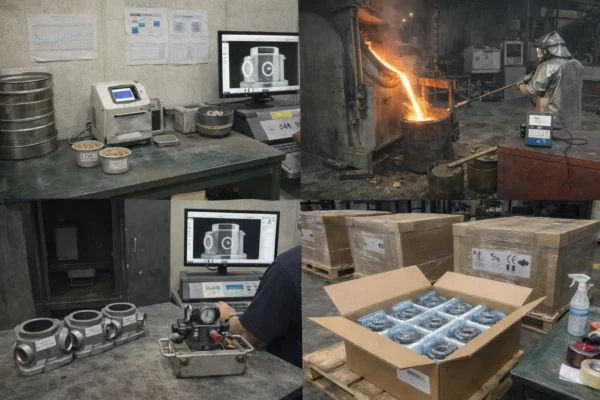
| 3. Melting & Analysis | Melting raw metal ingots and using a spectrometer to verify the alloy. | I’ve personally seen entire batches fail inspection because a factory got lazy with their spectrometer. It’s a non-negotiable step for us. |
| 4. Pouring & Cooling | Pouring the molten metal into the mold and controlling the cooling rate. | An uncontrolled cool creates internal stress and cracks that you can’t see, leading to failure under load. |
| 5. Ejection & Cleaning | Removing the part from the mold and cleaning off excess material. | This is the first look at the raw casting where our QC team catches any initial visual defects. |
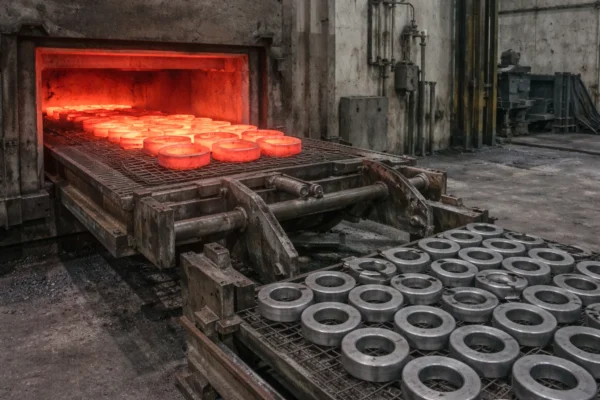
| 6. Finishing & Inspection | Secondary processing like machining, heat treatment, and final QC checks. | This final stage ensures that all our custom casting parts meet every dimensional and surface spec on your print. |
How Can You Really Trust the Quality from China?
Do you worry that a perfect sample won’t match the quality of the full production run? This fear of inconsistent quality is the biggest hurdle for international buyers.
Robust quality is built on a certified system like ISO 9001:2015, but true quality comes from rigorous in-process controls and transparent documentation. I always tell buyers: demand the paperwork. Promises are cheap, but a full PPAP submission is proof.

PPAP (Production Part Approval Process) is a framework originally developed by the Automotive Industry Action Group (AIAG) to ensure supplier processes are stable and repeatable. At our factory, it’s not an "add-on"; it’s how we operate. A standard submission includes:
- Full Dimensional Layout from our CMMs (Coordinate Measuring Machines).
- Material Test Reports from our spectrometer, tracing all the way back to the raw material batch.
- Process Flow Diagrams and Control Plans showing every step is monitored.
This automotive-level discipline is your insurance policy. We apply this same rigor whether we’re making complex castings or high-volume stamping parts.
Which Metal is Right for Your Part and Budget?
Are you unsure whether to use cast iron, steel, or aluminum? Choosing the wrong material is one of the most common and expensive mistakes, leading to parts that are too heavy, too weak, or too costly.
The right material depends on a balance of strength, weight, corrosion resistance, and budget. I always advise clients to think about the part’s entire life cycle. Saving a few cents on a cheaper alloy might seem smart, but if it leads to field failures later, the costs will be enormous.
| Material Group | Key Advantage | Common Industries | Cost Factor |
|---|---|---|---|
| Ductile Iron | Excellent strength, similar to steel but easier to cast. | Machinery, Automotive, Pipes | $ |
| Cast Steel | Superior durability and impact resistance. | Mining, Construction, Railway | $$$ |
| Aluminum Alloys | Lightweight, high conductivity, corrosion resistant. | Aerospace, Automotive, Electronics | $$ |
| Zinc Alloys | Excellent detail for complex shapes and fine features. | Hardware, Automotive Trim | $$ |
Frequently Asked Questions (FAQs)
What’s the difference between casting and forging?
Casting involves pouring molten metal into a mold to create a shape. Forging uses immense pressure to shape a solid piece of metal. According to sources like the American Foundry Society (AFS), forging is typically stronger but less capable of producing the complex shapes that casting excels at.
How do I protect my Intellectual Property (IP) in China?
Work with a reputable manufacturer who respects IP and is willing to sign a legally binding Non-Disclosure Agreement (NDA). A good partner understands that their business success depends on protecting yours. You can start that confidential conversation by contacting our team.
Do you handle secondary processes like machining and assembly?
Yes, absolutely. We are a one-stop shop. We integrate casting with precision CNC machining, surface treatment, and assembly to deliver a finished product. This saves you time and logistical headaches.
Your Next Step
China’s casting strength, combined with our 30+ years of on-the-ground experience, offers a reliable, high-quality, and transparent solution for your global industrial supply chain needs.

Ready to partner with an expert team that can bring your project to life with less risk and better results?