Struggling to find a metal stamping supplier in China that can handle high-stakes, industrial-grade projects? This uncertainty leads to production delays, quality failures, and critical supply chain risks. As the founder of a factory with over 30 years of experience, I’ve built this guide to help you identify a true manufacturing partner.

Finding a reliable China metal stamping supplier involves five key steps: 1. Verify they are a direct factory, not a trading company. 2. Validate core certifications like ISO 9001 and IATF 16949. 3. Assess deep technical capabilities, including automation and engineering software. 4. Demand proof of process control, such as PPAP documentation and SPC data. 5. Conduct a thorough factory audit, either remotely or in person.
I’ve been exporting globally since 1993. I’ve seen buyers get burned by suppliers who look good on paper but lack the robust systems needed for mission-critical production. A true partner doesn’t just "check" quality at the end; they build it into every step of the process. This guide reflects the level of scrutiny required for any global supply chain.
How Can You Properly Evaluate a Metal Stamping Supplier?
You have a shortlist, but how do you separate a basic workshop from a world-class manufacturing partner? The lowest price often hides the highest long-term cost. A professional evaluation must go beyond the surface to verify their processes, equipment, and risk management systems.

A professional evaluation verifies certifications like ISO 9001, assesses their automation and engineering software ecosystem, and dives deep into their quality systems by demanding PPAP capabilities, SPC data, and proof of equipment calibration traceability to international standards.
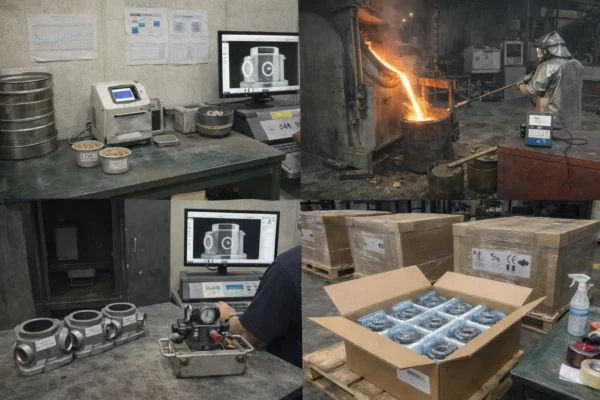
Any factory can own a CMM machine. The real question is, is that equipment calibrated per ISO/IEC 17025 standards? Is the data simply used to pass or fail parts, or is it digitally stored and traceable to the specific operator, machine, and batch number to control the process in real-time? These are the questions that define a professional partner.

A. Quality Control: Moving from Inspection to Prevention
A world-class supplier focuses on process control, not just final inspection. Their goal is to prevent defects from ever occurring.
- PPAP/APQP Capabilities: Can the supplier submit a complete PPAP (Production Part Approval Process) package, such as a Level 3 submission? This demonstrates their understanding of automotive-grade requirements, including Process Flow Diagrams, FMEAs, and Control Plans. It’s a non-negotiable for any serious project.
- Statistical Process Control (SPC): How do they use Statistical Process Control (SPC) to monitor critical-to-quality (CTQ) dimensions in real-time? Ask for sample SPC charts (X-bar & R) to see how they track process capability (Cpk) and prove their management is data-driven.
- Calibration and Traceability: How are their measuring devices calibrated? Ask for records showing traceability to national or international standards. Without this, their measurement data is unreliable.

B. Technical & Engineering Capabilities: Beyond Press Tonnage
You need to understand a supplier’s process range, automation level, and engineering depth.
- Automated Stamping Cells: Prime operates dedicated, high-speed Automated Stamping Cells utilizing modern coil feeding and high-speed transfer systems on our AIDA and Chin Fong presses. This advanced setup minimizes manual handling, reduces variability, and ensures consistently high Cpk results.
- Engineering Software Ecosystem: What specific software do their engineers use? Look for industry standards like SolidWorks, CATIA, or UG (NX). For complex forming, ask if they use CAE simulation software like Dynaform to solve material stress issues before a tool is ever cut.
- In-House Tooling and Maintenance: An in-house tool room is critical. It allows for rapid repairs and proactive maintenance, minimizing downtime.

C. Tooling Ownership & Longevity: A Critical Discussion
For high-value projects, the stamping die (tooling) is a significant investment. The terms must be crystal clear.
- Ownership & Custody: The purchase order must explicitly state that you, the customer, are the sole owner of the tooling.
- Die Life Guarantee: What is the guaranteed number of strokes for the tool (e.g., 1,000,000 strokes)? This must be documented.
- Repair Timeframe: What is the guaranteed response time for tool repair? A press being down for days is unacceptable for a high-volume part.

Risk Management: A 360-Degree View
Beyond the part itself, a true partner helps you manage broader supply chain risks, from material integrity to global logistics.
Material Traceability and IP Protection
- Material Traceability: We insist that every single shipment is accompanied by the corresponding Material Test Reports (MTRs) for the raw material used. These MTRs are traceable to the production lot and the original heat number from the steel mill, creating an unbroken chain of documentation.
- Intellectual Property (IP) Protection: We understand and strictly adhere to international IP protection protocols. We will always sign a robust Non-Disclosure Agreement (NDA) to protect your design assets.

Supply Chain Resilience and Logistics
- Logistics Expertise: We are proficient in all major INCOTERMS (FOB, CIF, DDP). Our dedicated logistics team can manage the entire process, from our factory floor to your warehouse door, including international freight, customs clearance, and duty management.
- Business Continuity: As a factory operating for over 30 years, we have a robust Business Continuity Plan (BCP). We implement rigorous preventive maintenance schedules for all critical equipment, ensuring over 98% uptime and mitigating unforeseen disruptions.
Beyond Quality: Our Commitment to ESG and Social Responsibility
For modern global brands, compliance is non-negotiable. Your manufacturing partner must meet international standards for environmental and social governance.
- Environmental Management: In addition to quality certifications, we hold an ISO 14001 Environmental Management System certification. This ensures our processes comply with international environmental standards and that your products meet stringent regulations like REACH and RoHS.
- Social Responsibility: We welcome third-party social responsibility audits (e.g., SMETA/Sedex). We are committed to fair labor practices and strictly adhere to all anti-child labor and anti-forced labor laws, protecting your brand’s reputation.
Ready to Move from Quoting to True Partnership?
Don’t just send a drawing for a price. Demand a professional engineering review to assess feasibility and uncover savings.
Prime invites you to send your 2D engineering drawings and 3D CAD models. Our engineering team will provide a free, no-obligation DFM (Design For Manufacturability) preliminary analysis within 48 hours. This report will identify potential manufacturing risks, suggest cost-saving optimizations, and prove our technical competence before you commit.