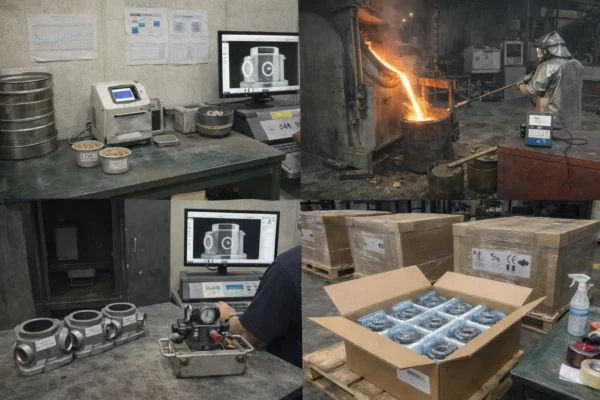
When choosing between free forging1 and closed-die forging2 for heavy machinery, precision, efficiency, and cost play crucial roles. This article will explore the fundamental processes and applications of both methods, their advantages, and cost analysis to help you decide which is best for your needs.

Free Forging Fundamentals – Process, suitable part types (shafts, rings).
Free forging1 is a manufacturing process2 where the metal is deformed by direct blows from a hammer or through a press. It is particularly useful for producing simple, axially symmetric parts, such as shafts and rings.
Process
Free forging1 involves placing the metal stock2 between the anvil and the die, then using a hammer or pressing it to shape the part. The metal is deformed under the force, and the final shape is achieved through a series of blows.
Suitable Part Types
Shafts and rings are commonly forged using free forging1. These parts benefit from the process because they require simple, axially symmetric shapes2 and can be produced in large quantities.

Example
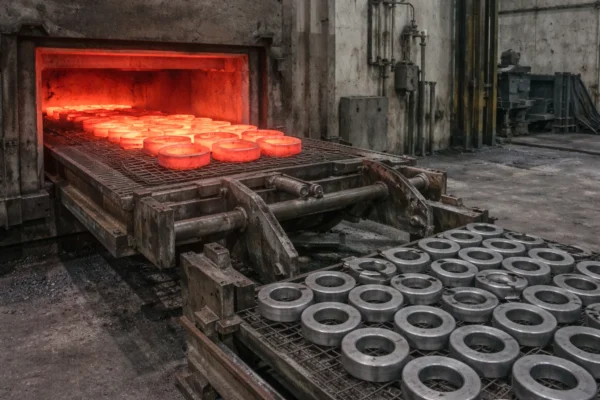
Imagine you need a large ring1 for a machine. Using free forging2, the ring can be shaped by direct blows from a hammer, resulting in a part that is both strong and cost-effective.
Closed-Die Forging Explained – High-Precision, Repeatability & Scalability.
Closed-die forging1 is a more precise form of metalworking where the metal is placed in a shaped die and subject to pressure. This method allows for high precision, repeatability, and scalability, making it ideal for specialized heavy machinery components2.
Process
In closed-die forging1, the metal is placed in a pre-made die cavity2 and then pressed to reform the metal into the desired shape. The internal geometry of the die ensures that the metal perfectly fits into the required shape.
Suitable Part Types
Components requiring high precision and intricate internal features, such as sprockets and gear housings1, are best produced using closed-die forging2.

Example
Consider a need for a gear housing1 with intricate internal features. Using closed-die forging2, the gear housing1 can be manufactured with high precision, ensuring it fits perfectly into the machine.
Industrial Comparisons – Heavy Machinery, Mining, Pressure Vessels.
Both free forging1 and closed-die forging2 have their place in the industrial world, especially for heavy machinery, mining equipment, and pressure vessels. Each method suits different applications based on the requirements of the part.
Heavy Machinery
Heavy machinery often requires parts like shafts, gears, and sprockets. Free forging1 is suitable for these parts due to its ability to produce large, simple parts in a cost-effective manner.
Mining
In the mining industry, components like shafts and tie rods need to be robust and durable. Free forging1 excels in this area, as it can produce high-quality, cost-effective parts2.
Pressure Vessels
Pressure vessels require high precision and strength. Closed-die forging1 is the preferred method here, as it provides the necessary precision and repeatability for critical components.

Cost & Production Time Analysis – Which Delivers Better ROI?
Cost Analysis
Free forging1 is generally more cost-effective for producing simple, bulky parts in large quantities. However, the accuracy and repeatability of closed-die forging2 can reduce long-term maintenance costs.
Production Time
Free forging1 can be faster for simple, one-off parts due to the direct shaping process. Closed-die forging2, while more precise, can take longer to set up and manufacture each part.
Example
For a large-scale production of shafts for heavy machinery, free forging1 might be more economical. However, for specialized gear components, closed-die forging2 would be more cost-effective due to the high precision and durability it provides.
My Insights
In conclusion, both free forging1 and closed-die forging2 have their advantages in the heavy machinery industry. Free forging is ideal for producing simple, bulky parts quickly and cost-effectively, while closed-die forging2 is best for precision and repeatable parts that require high accuracy. The choice depends on the specific requirements of the part and the overall cost-benefit analysis.

Conclusion
Whether you choose free forging1 or closed-die forging2, the decision can significantly impact the performance and cost-effectiveness of your project. Understanding the processes, applications, and benefits of each method can help you make an informed decision for your heavy machinery needs.