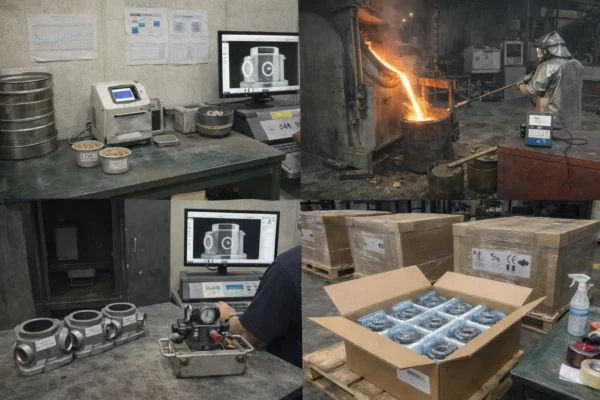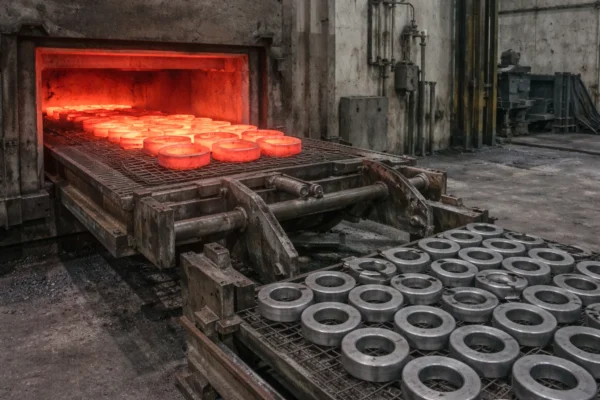
Worried your custom cast parts will fail under pressure? Poor quality leads to costly recalls1, damages your brand, and erodes profits. Strict, end-to-end quality control2 is the only way to protect your investment.
To guarantee quality in custom metal casting, you must master four areas: implementing key quality standards like ISO 9001, selecting the right materials for the job, mastering mold design and process control, and using advanced inspection methods. This systematic approach ensures every part meets your exact specifications.

Getting quality right isn’t a single action; it’s a complete system built on expertise and trust. In my 30+ years of running Prime Fabworks, I’ve learned that overlooking one small detail can cause major problems. I remember a client, Mark, who procures parts for Siemens in the U.S. He came to us after a bad batch from a previous supplier, with inconsistent wall thickness, nearly cost him a major contract. It’s why our approach to custom metal casting services is so rigorous from the very first conversation.
What are the Key Quality Standards for Custom Metal Casting Parts?
Struggling with inconsistent parts from your supplier? One batch is perfect, but the next fails inspection. This uncertainty costs you time, money, and customer trust. A clear, internationally recognized standard is the answer.
The most important quality standard is ISO 9001:2015, which, as defined by the International Organization for Standardization, outlines a complete quality management system. Others, like those from the American Society for Testing and Materials (ASTM), provide specific rules for material composition and performance. For many of our automotive and industrial clients, we provide a full Production Part Approval Process (PPAP) package. This isn’t just paperwork; it’s your objective proof that our process is stable and will consistently produce parts that meet your exact specifications before the main production run ever begins.

When we first started working with international clients, their biggest concern was consistency. They needed to know that the ten-thousandth part would be identical to the first. This is where standards become non-negotiable. They are the common language of quality in global manufacturing. Many see ISO 9001 certification as a hurdle, but I see it as the blueprint for our entire operation. It dictates how we handle everything, from raw material intake to final inspection and shipping.
Key International Standards in Casting
| Standard Type | Governing Body | Primary Function | Example Application |
|---|---|---|---|
| Quality Management | ISO | Defines the overall process for ensuring quality. | ISO 9001:2015 requires documented procedures for all production stages. |
| Material Specs | ASTM | Defines chemical composition and mechanical properties. | ASTM A48 specifies the grade of Gray Iron to be used. |
| Dimensional Tolerance | DIN / ISO | Sets acceptable variations for part dimensions. | ISO 2768 sets general tolerances for linear and angular dimensions. |
| Process Validation | AIAG | Standardizes pre-production approval processes. | PPAP ensures process capability before mass production. |
How Does Material Selection Impact Casting Accuracy and Strength?
Ever had a part crack, deform, or wear out too soon? The wrong metal choice is often the culprit. This leads to product failure and expensive replacements.
The material you choose directly controls the final product’s performance. As detailed in resources like the ASM Handbook, factors like the alloy’s shrinkage rate affect dimensional accuracy, while its composition determines strength and corrosion resistance. Choosing the right material for the application is the first step to a reliable part.

I remember a project for an automotive client who needed a bracket to withstand high engine temperatures and constant vibration. The initial material they suggested was a standard cast iron, chosen to save on cost. I knew from experience this wouldn’t work; the heat would cause creep and embrittlement over time. I showed them data on a specific grade of ductile iron with nickel additives. It cost slightly more, but it offered superior thermal stability. They agreed to a test run, and the parts performed perfectly. This highlights the critical balance between cost and performance that experienced buyers understand.
Cost vs. Performance Trade-offs
| Material | Relative Cost | Key Advantages | Best For |
|---|---|---|---|
| Gray Cast Iron | Low | Excellent dampening, good machinability | Machine bases, engine blocks |
| Ductile Iron | Medium | Higher strength and ductility than gray iron | Gears, suspension parts |
| Carbon Steel | Medium | High strength and toughness | Structural components, high-stress parts |
| Aluminum Alloys | Medium-High | Lightweight, corrosion-resistant | Automotive parts, electronic housings |
| Stainless Steel | High | Excellent corrosion and heat resistance | Food processing, medical equipment |
How Does Mold Design Influence Casting Quality?
Have you received cast parts with surface defects or incorrect dimensions? A flawless material can still produce a bad part if the mold design and process control are weak.
The mold is the heart of the casting process. Its design, including the gating and riser system, controls how molten metal flows and solidifies. Proper design prevents common defects like porosity, shrinkage, and "hot tears," ensuring the part is solid and dimensionally accurate.

Early in my career, we faced a recurring issue with a complex part that had small, internal voids. We checked the material and the melting process, but the problem persisted. Finally, our most experienced engineer re-examined the mold design. He realized the gating system—the channels that feed metal into the mold cavity—was causing turbulence, trapping air bubbles. We redesigned the gates to create a smoother, laminar flow. The next batch of parts was perfect. This is a perfect example of why our front-end engineering is a core part of our Quality Assurance process.
What is the Role of Advanced Inspection Methods like X-Ray and CMM?
You can’t see internal defects with your eyes. A part might look perfect but hide a critical flaw, leading to unexpected failure and safety risks.
Advanced inspection methods let us see inside the part and measure it with incredible precision. Methods like X-ray find internal defects, CMM verifies complex geometries, and ultrasonic testing detects subsurface cracks. These tools are essential for guaranteeing a part is 100% sound.

For high-stakes industries like aerospace or oil and gas, visual inspection is not enough. We once manufactured critical components for a pumping system where any internal porosity could cause a catastrophic failure under pressure. We used X-ray inspection on every single part. We found tiny, invisible gas pockets in a few parts and rejected them immediately. Our client was grateful, as this prevented a dangerous situation in the field. This solidified my belief that investing in advanced inspection is not a cost, but an essential insurance policy for both our clients and ourselves.
Choosing the Right Inspection Method
| Inspection Method | What It Detects | Best Application |
|---|---|---|
| Visual/Dimensional | Surface defects, incorrect dimensions | Basic quality check for all parts |
| CMM | Precise geometric and dimensional accuracy | Complex parts with tight tolerances |
| X-Ray (RT) | Internal voids, porosity, inclusions | Critical parts where internal soundness is crucial |
| Ultrasonic (UT) | Subsurface cracks and flaws | Thick-section parts, weld inspections |
| Magnetic Particle (MPI) | Surface / near-surface cracks (ferrous only) | High-stress ferrous components like shafts |
Why Should You Partner with an ISO-Certified Foundry?
Working with an uncertified supplier feels like a gamble. You might face inconsistent quality, missed deadlines, and poor communication, putting your entire project and reputation at risk.
Partnering with an ISO-certified foundry like ours means you are working with a proven system. ISO 9001 certification isn’t just about quality; it’s about process control, traceability, and continuous improvement. This systemic approach is the foundation of trust that is essential for a long-term business relationship with clients who demand perfection. It’s the reason companies choose to partner with us.

The ISO 9001 Advantage: A Step-by-Step Process
| Stage | Our Action (Driven by ISO 9001) | Your Benefit |
|---|---|---|
| 1. Quotation | Review of drawings & specs to ensure feasibility. | Clear, accurate pricing and lead times. |
| 2. Order Kick-off | Creation of a detailed Production Control Plan. | Full visibility and alignment on quality checks. |
| 3. Production | Adherence to documented work instructions at each step. | Consistent manufacturing process for every part. |
| 4. Inspection | Use of calibrated tools and defined inspection points. | Verifiable proof that your parts meet spec. |
| 5. Documentation | Generation of material certs & inspection reports (PPAP). | Full traceability and quality assurance records. |
Conclusion
A systematic approach—using standards, smart material selection, precise process control, and advanced inspection—is the key to quality custom casting. It’s how we guarantee reliability for every single part.
Frequently Asked Questions (FAQs)
1. What are the most common defects in metal casting and how do you prevent them?
Common defects include porosity (gas bubbles), shrinkage (voids from cooling), and surface cracks. We prevent these through careful mold design using flow simulation, precise control of metal temperature, and by using risers in the mold to feed the casting as it solidifies.
2. How much does a custom metal casting cost?
The cost depends on several factors: the complexity of the design, the type of metal, the size and weight, the required tolerances, and the order quantity. We provide a detailed quote after reviewing your 3D model and specifications.
3. What is the typical lead time for a custom casting order?
Lead time has two parts: tooling (mold making) and production. Tooling typically takes 4-6 weeks. Once the mold is approved, mass production can range from 3-5 weeks depending on the quantity and complexity. We always provide a specific schedule with our quote.
4. What information do I need to provide to get a quote?
To give you an accurate quote, we need a 3D CAD file (STEP or IGS), a 2D drawing with tolerances, the material specification, finishing or testing requirements, and the order quantity. You can provide this information on our Request for Quote page.
Ready to Start Your Next Casting Project?
Eliminate the risk of poor quality and delivery delays. Partner with a proven, ISO-certified expert.