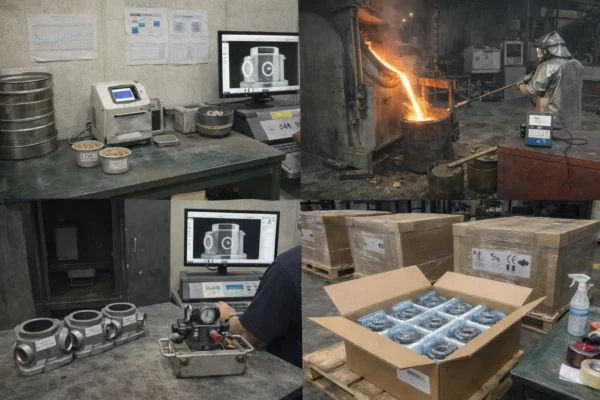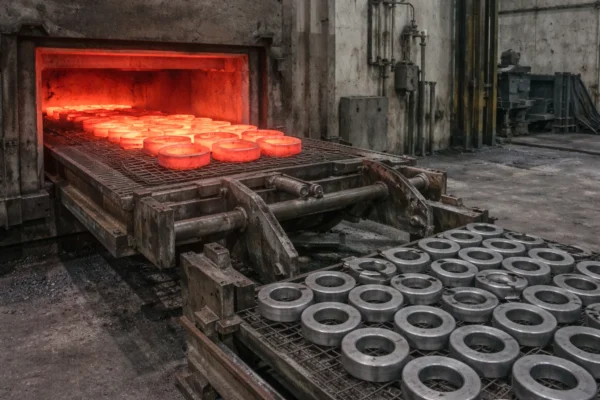
What Is China Investment Casting?
China investment casting is the practice of sourcing precision lost-wax castings from Chinese foundries that combine casting, CNC machining, and surface treatment under one roof to reduce part cost by 15–35% while still meeting Western quality and delivery standards.
For many OEMs and industrial buyers, China has become the default option for stainless steel, carbon steel, and heat-resistant steel castings. But lower unit prices alone are not enough. The real challenge is how to reduce total cost and control risk without sacrificing quality or lead time.
In this 2025 guide, we’ll walk through:
- Why more global OEMs are shifting investment casting projects to China
- The 8 key criteria1 to evaluate a Chinese investment casting supplier
- Common risks and red flags – and how to avoid them
- How to send RFQs that lead to accurate quotes and fewer surprises
- Real case studies of buyers who successfully moved projects to China

At the end, you’ll find a clear checklist you can use immediately when talking to potential suppliers.
Why Are Leading OEMs Moving Investment Castings to China?
Leading OEMs move investment casting projects to China mainly to reduce piece price, increase capacity, and consolidate casting + machining + finishing in one supply chain.
Typical reasons include:
-
Cost reduction:
Labor and overhead costs are still significantly lower than in North America or Western Europe. For many projects, buyers see 15–35% lower unit costs compared with domestic casting plus machining. -
Capacity and flexibility:
Chinese foundries often have multiple lines for waxing, shell building, melting, and heat treatment, allowing them to handle both small batches and mass production. -
One-stop service:
Many suppliers combine investment casting, sand casting, CNC machining, heat treatment, surface treatment, and packing in one place. This reduces coordination work, transport time between suppliers, and quality variation. -
Access to a wide material range:
From standard carbon steel to duplex stainless steels and heat-resistant grades such as 1.4823, experienced Chinese foundries can usually cover the full spectrum.

However, these advantages only appear if you pick the right supplier2 and manage the project properly. Choosing the wrong foundry can lead to the exact opposite: quality problems, delays, hidden costs, and damaged reputation.
What Are the 8 Key Criteria for Evaluating an Investment Casting Supplier in China?
The 8 key criteria for evaluating a China investment casting supplier are: material expertise, casting range, in-house machining, tooling capability, testing & NDT, certified quality system, engineering support, and proven delivery performance.
1. Material and Process Expertise
- Experience with your specific material grades (e.g., CF8/CF8M, duplex, heat-resistant steel)
- Ability to recommend equivalent grades if your drawing uses a local standard
- Understanding of casting defects and how to prevent them for each material
Questions to ask:
- “How many years have you been casting this material?”
- “Can you share photos or case studies of similar parts?”
2. Casting Size and Weight Range
- Minimum and maximum part weight they can cast reliably
- Maximum overall dimensions
- Experience with thin-wall, complex geometry, or heavy sections
If your part is close to the limits, you need the foundry to prove that they can control distortion and defects.
3. In-House Machining and Finishing
- Availability of CNC turning, milling, drilling, tapping, grinding
- Surface treatment options: shot blasting, pickling, passivation, coating
- Ability to deliver ready-to-assemble parts1 instead of raw castings
One-stop casting + machining often reduces total cost and lead time, especially for industrial OEMs.

4. Tooling and Pattern Control
- Whether tooling is made in-house or outsourced
- How patterns are stored, maintained, and modified
- Typical tooling lead time, and how many shots each tool can support
Good tooling management means more stable quality and fewer surprises over the life of the project.
5. Testing and Inspection Capability
- Spectrometer for 100% heat-by-heat chemical analysis2
- Mechanical testing (tensile, impact) when required
- Hardness testing (Brinell, Rockwell)
- Non-destructive testing1 (PT, MT, RT) in-house or via certified partners
- Dimensional inspection tools: CMM, gauges, fixtures

For critical parts, you may also need PPAP-style documentation or 3.1 MTCs according to EN 10204 issued by the foundry for your casting heats.
6. Quality System and Traceability
- ISO 9001 certification (and IATF 16949 for automotive if needed)
- Clear procedures for incoming material control, in-process control, and final inspection
- Traceability from heat number to casting, machining, and final packing labels
Ask the supplier to show sample inspection reports and MTCs that match your drawing and standards. For your internal team, it also helps to review typical defect modes in castings, such as porosity or shrinkage, using resources like this Beginner’s Guide to Metal Casting Defects. ([MetalTek][2])
If you want to compare how different foundries manage quality, you can cross-check with our own overview of Top-Rated Custom Casting Suppliers in China: Quality, Capacity, and Price. ([Prime Custom Parts][3])
7. Engineering Support and Communication
- Ability to read and understand 2D & 3D drawings (STEP, X_T, etc.)
- Capability to provide DFM suggestions (design for manufacturability) specifically for cast parts
- Response time to technical questions and non-conformities
You want a partner who can say “we see a risk here, we suggest this change”, not just “we will try.” For complex investment castings, design rules such as wall thickness, radii, and gating-friendly transitions are essential – see, for example, these Investment Casting Design Guidelines for Engineers. ([Unideritend][4])
From our side, we summarize this buyer–foundry collaboration in How to Choose the Right Metal Casting Parts? A Complete Guide from Custom Prototypes to Mass Production. ([Prime Custom Parts][5])
8. Delivery and Logistics Performance
- Standard lead time for tooling, samples, and production batches
- On-time delivery record for existing customers
- Ability to support air shipments for urgent orders of cast components
- Familiarity with export packing, palletizing, and container loading
For heavy castings, you should verify that the supplier has experience with export packing for casting parts—including blocked & braced pallets, rust-prevention methods, and labeled wooden cases suitable for sea freight. Our article Centrifugal & High Pressure Casting: Heavy-Duty Metal Solutions also touches on typical applications and shipping considerations for heavy-duty castings. ([Prime Custom Parts][6])
What Red Flags Should You Watch Out for When Sourcing Investment Casting in China?
Major red flags when sourcing investment castings in China include unrealistic low prices, lack of material traceability, no real inspection data, inconsistent communication, and a factory that avoids video calls or on-site audits. A good reference point is the Investment Casting Purchasing Guidelines, which outline how a normal purchasing process for investment casting should look. ([Investment Casting Foundry][7])
Key warning signs:
- Price is much lower than other quotes, but the supplier cannot clearly explain process route, casting material, or inspection details.
- Cannot show real photos or videos of their casting workshops (wax room, shell making, pouring, fettling) – or all photos look like stock images.
- Refuse to share sample MTCs and inspection reports with heat numbers and chemical composition for cast heats.
- Frequent changes of contact person; email responses are vague or copied from templates.
- No clear answer about who owns the tooling, where it is stored, and how to handle future modifications for the casting dies.
- Incoterms, payment terms, and responsibilities are not defined clearly in offers or contracts for castings.
When you see more than two or three of these red flags, it is usually safer to walk away early rather than learn the hard way with a failed casting project.
If you already have problems on the table (porosity, shrinkage, cracks, dimensional instability), you can benchmark against our own troubleshooting guide: Common Problems and Solutions of Metal Casting Parts. ([Prime Custom Parts][8])
How to Create an RFQ for Investment Casting That Gets Accurate Quotes and Fewer Problems
To get accurate quotes and stable quality, your RFQ for investment casting from China must clearly define drawings, material, quantities, tolerances, surface requirements, tests, and packing details. Before sending the RFQ, many buyers find it useful to read an overview such as the Investment Casting Guide for Engineers and Buyers, which walks through process, materials, and applications for investment-cast parts. ([Investacast][9])
Essential Items for Your RFQ
Use this checklist when preparing your RFQ:
- 2D engineering drawings with all dimensions, tolerances, and notes
- 3D model (STEP, X_T, etc.) if available – very helpful for complex investment castings
- Material grade (e.g., ASTM A351 CF8M / EN 1.4408 / 1.4823) and any accepted equivalents
- Quantity information: first order quantity + annual volume for the casting parts
- Casting process if you have a preference (investment casting, sand casting, etc.) – if you are still choosing, see our comparison in How to Choose the Right Metal Casting Parts?. ([Prime Custom Parts][5])
- Surface condition: as-cast, shot blasted, machined, pickled, passivated, coated
- Critical dimensions and surfaces: where tolerances are strict and failure is unacceptable on the finished casting
- Testing requirements: chemical, mechanical, hardness, NDT (PT/MT/RT), pressure tests – you can align these with commonly observed defect modes in articles like this Practical Guide to Metal Casting: From Basics to Fixes. ([PTSMAKE][10])
- Documentation: MTC 3.1, dimensional reports on cast and machined features, PPAP level if needed for critical casting parts
- Packing and shipping requirements: pallet or wooden case, rust prevention, labels, pallet size limits
If your engineering or sourcing team wants to go deeper into casting-specific knowledge before finalizing the RFQ, these internal resources may help:
- How to Choose the Right Metal Casting Parts? A Complete Guide from Custom Prototypes to Mass Production ([Prime Custom Parts][5])
- Common Problems and Solutions of Metal Casting Parts ([Prime Custom Parts][8])
- Top 15 Metal Casting Parts Manufacturers in 2025 ([Prime Custom Parts][11])

Example: “Bad RFQ” vs “Good RFQ”
-
A bad RFQ only says:
“Please quote this stainless steel investment casting, material 304, quantity 1,000 pcs.” -
A good RFQ includes:
- PDF drawing + STEP model
- Material: CF8M / 1.4408 or equivalent
- Annual usage: 12,000 pcs; first order 1,000 pcs
- Surface: shot blasted, machining on flange and bore, Ra max …
- NDT: PT on all machined surfaces
- Documents: MTC 3.1 + dimension report
- Packing: seaworthy wooden cases, max weight per case, marking requirements
The second RFQ might take an extra 10–15 minutes to prepare, but it can save weeks of back-and-forth emails and avoid quotes that are not comparable.
Typical Costs, MOQ, and Lead Times for Investment Casting in China
Most China investment casting suppliers work with a tooling cost plus a per-piece price, with sample lead times of 3–6 weeks and production lead times of 4–8 weeks depending on complexity and volume.
While every project is different, you can expect:
-
- Simple parts: a few hundred USD
- Complex, multi-cavity tooling: several thousand USD
-
Minimum order quantity (MOQ)1:
- Some suppliers accept 50–100 pcs for regular reorder, especially for high-value parts
- Others may require 300–500 pcs depending on casting size and setup time
-
- Tooling: typically 3–5 weeks after order
- Samples: 2–4 weeks after tooling ready
- Mass production: 4–8 weeks after sample approval and deposit
-
Price breaks:
- Unit price usually drops at certain quantity levels (e.g., 100 / 300 / 1,000 / 5,000 pcs).
-
Real Case Study: European OEM Reduces Cost and Stabilizes Quality
Background
A European OEM producing industrial valves had been purchasing stainless steel investment castings from a local foundry for years. The parts were critical components with complex geometry and tight machining tolerances.
- Material: EN 1.4408 (CF8M)
- Annual quantity: ~6,000 pcs across several part numbers
- Pain points:
- High unit price
- Long and unpredictable lead times
- Occasional porosity issues revealed during machining
How the Project Was Moved to China
The buyer decided to evaluate Chinese foundries and worked with Prime as a potential partner.
We followed this process:
- Drawing and RFQ review
- Confirmed material and tolerances
- Suggested minor changes to wall thickness to improve feeding
- Tooling and sampling
- Designed dedicated tooling for each part
- Provided first article samples with MTCs and dimension reports
- Adjusted runners and risers after first trial to remove local shrinkage
- Process validation
- Ran small pilot batch and monitored rejection causes
- Implemented additional in-process inspection on critical dimensions
- Mass production and logistics
- Set up a regular monthly schedule based on forecast
- Packed parts in labeled wooden cases with heat number and part number for full traceability

Results
Within the first year:
- Unit cost reduced by around 20–25% compared with the previous local supplier
- On-time delivery above 98% thanks to stable production planning
- Rejection rate during machining dropped significantly due to improved gating design and inspection
The customer went on to transfer additional part numbers to the same supply chain.
FAQ: Common Questions About China Investment Casting
Q1. Is China investment casting only about low price?
No. While cost reduction is important2, the most successful projects focus equally on quality, lead time, and risk control. The best Chinese foundries offer full documentation, consistent communication, and long-term support rather than just the lowest quote.
Q2. How can I reduce risk when starting with a new Chinese foundry?
Start with:
- A well-defined RFQ1 with complete drawings and requirements
- Clear quality and inspection plan
- A step-by-step approach: tooling → samples → pilot batch → full production
- Third-party inspection or on-site audit for the first shipments if the project is critical
Q3. Do I always need to visit the factory in person?
Factory visits are helpful, but not always required at the very beginning. Today, many buyers use video calls, live factory tours, and third-party audits to verify capabilities before placing the first order. For high-value or safety-critical projects, an in-person visit is still strongly recommended.
Q4. Can Chinese foundries handle PPAP and automotive requirements?
Yes, some can. When PPAP or IATF-level documentation is required, you must select suppliers with proven experience in automotive or similar sectors. Ask for sample control plans, process flow charts, and previous PPAP packages.
Q5. What is the best way to ship investment castings from China?
Most buyers use sea freight (FCL or LCL) for standard orders and air freight for urgent replacements. Make sure your supplier understands export packing, rust prevention, palletization rules, and can work with your forwarder or provide CIF/CFR options.
Ready to Discuss Your Investment Casting Project in China?
If you are planning to move your investment casting project to China – or you are not satisfied with your current supplier – our engineering team can help you evaluate feasibility, cost, and risk.
- We can review your drawings, material specifications, and annual usage
- Suggest the most suitable casting process and machining route
- Provide a clear quotation with tooling, sample, and production lead times
Send your RFQ or sample drawings to our email or upload them via our contact form.
We usually reply within 24 hours with practical suggestions and a detailed quotation.
Internal links you may want to add after publishing:
- Link the phrase “investment casting supplier in China” to your main casting service page.
- Link RFQ checklist to a downloadable RFQ template page.
- Link heat-resistant steel castings (1.4823 / 1.4743) to the specialized article we outlined before
Need detailed specifications, process flow, and pricing guidance? Explore our full Tank Page here: View Complete Guide
-
A well-defined RFQ is crucial for successful projects; learn how to craft one for better outcomes. ↩ ↩ ↩ ↩ ↩
-
Understanding cost reduction can help you balance quality and price effectively in your projects. ↩ ↩ ↩ ↩
-
Lead times impact project timelines; knowing them helps in planning and scheduling production. ↩
-
Exploring how annual usage influences pricing can lead to significant cost savings in your projects. ↩