
You fight leaks, delays, and quality doubts every year. You need castings that protect both your projects and your reputation.
Investment casting pump components and valve components give tight tolerances, thin walls, and smooth internal passages in one stable process. This reduces machining time, protects hydraulic efficiency, and improves leakage performance. When you work with an ISO 9001 based pump casting supplier and valve body casting manufacturer, you also gain traceability, documented PPAP support, and more stable long-term cost.
I am a technical sales director at Prime with over 15 years in pump and valve castings. Every week I review RFQs, pressure test reports, and NDT findings with OEM teams. In this guide I speak as both factory and partner, so you can source from China with less risk and more control.
Why do pump and valve OEMs move to investment casting components?
You probably feel pressure from both engineering and finance. Engineering teams want complex shapes and smooth flow. Finance wants lower total cost and fewer line stops. Old sand castings rarely satisfy both sides.
Pump and valve OEMs move to investment casting because it handles curved passages, thin walls, and fine details in a repeatable way. The process delivers near-net-shape components, so you cut machining and keep flow geometry close to the design model. For impellers, casings, and valve bodies, investment casting often gives the best balance between performance, quality risk, and lifetime cost.

Which pump and valve parts benefit most?
In my projects, the biggest wins appear on “wet parts” and pressure containing parts:
| Component type | Role in the system | Investment casting benefit |
|---|---|---|
| Pump impeller | Transfers energy to the fluid | Smooth blades and accurate profiles |
| Pump casing / volute | Guides flow and builds pressure | Complex channels with less machining |
| Diffuser housing | Controls flow leaving the impeller | Thin vanes and tight geometry |
| Valve body | Holds pressure and defines flow path | Integrated bosses and stable wall thickness |
| Valve bonnet / cover | Closes body and supports stem and packing | Flat faces and accurate bolt circles |
| Valve trim components | Regulates or shuts off flow | Fine details and good surface finish |
So instead of welding many small components, you design one integrated investment casting valve component. You then reduce welds, gaskets, and potential leakage points.
If you also need precise faces and threads, our group combines investment casting with CNC machining parts. This one-stop chain helps you control tolerances from design to assembly.
How should you choose materials for pump and valve casting projects?
A wrong alloy can stay hidden until the pump or valve runs at full load. Then corrosion, cracking, or erosion appears. At that point, the cost hits your warranty budget and your brand.
You should choose casting materials for pump and valve components based on fluid, temperature, and pressure class. Carbon steels suit water and utility service. Austenitic stainless grades such as CF8M handle many chemical fluids. Duplex stainless steels work better in seawater and chloride rich media. For hot valves, heat resistant steels give safer margins and longer life.

How do we match alloys to applications?
In every RFQ review I start with three questions: which fluid, which temperature range, and which pressure class. Then I map these answers to standard casting alloys. For a deeper dive you can also review our guide on selecting the right alloy for metal casting applications.
| Application area | Typical condition | Material group | Example grades |
|---|---|---|---|
| Clean water pumps | Neutral water, low chloride | Carbon steel | WCB, GP240GH |
| Utility and steam valves | Steam, oils, non-aggressive media | Carbon and low alloy steel | WCB, WC6 |
| Chemical process pumps and valves | Acids, solvents, higher chlorides | Austenitic stainless | CF8M, CF3M |
| Seawater and desalination systems | High chloride, crevice corrosion risk | Duplex and super duplex stainless | CD3MN, CE3MN |
| High temperature valves | Hot steam, thermal cycling | Heat resistant steels | WC9 and similar grades |
CF8M, for example, is defined in ASTM A351 as an austenitic stainless casting alloy for pressure containing parts such as valves and pumps.It is the cast equivalent of 316 stainless and fits many aggressive media.
When you send drawings for investment casting pump components or valve body casting components, please include this service data. Then I can suggest one or two safe alloys, not twenty confusing options.
How do we control material risk?
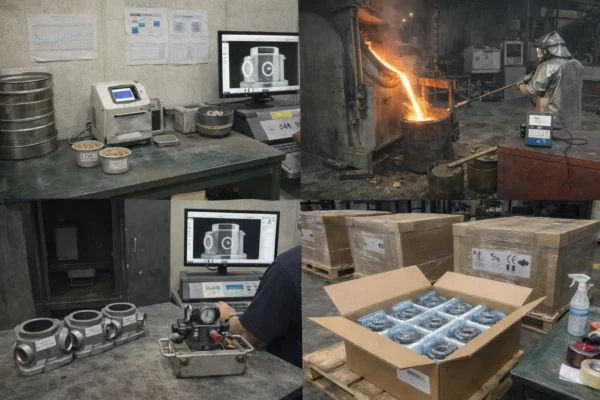
I never rely only on paper certificates. At Prime we run an ISO 9001 based quality system that covers material, process, and documentation control.(International Organization for Standardization)
| Control item | Buyer benefit | Typical method |
|---|---|---|
| Spectrometer check | Confirms correct chemistry | Stationary spectrometer |
| Mechanical test coupons | Confirms strength and ductility | Tensile testing machine |
| NDT on critical zones | Finds hidden cracks and porosity | PT, RT, or UT |
| Traceable heat numbers | Links each casting to its material data | Casting marks and labels |
For NDT method selection, you can also refer to ASNT’s overview of nondestructive testing methods.
These results feed into PPAP style packages when your end customer demands them. So you can show clear, structured material control in your own audits.

What quality and testing requirements should you set for investment castings?
Many suppliers promise “high quality” in slides, but they do not define it. As a buyer you live with the hard side: failed pressure tests, rework, blocked lines, and emergency air freight.
You should set clear and measurable quality requirements for investment casting pump components and valve components. These include 100% pressure tests for pressure containing castings, defined leakage criteria, NDT levels for critical zones, and dimensional tolerances on sealing and bearing areas. A mature pump casting supplier documents each check under an ISO 9001 quality system and links it to part and heat numbers.

What does a robust inspection plan look like?
For most OEMs I propose an inspection and test plan at RFQ stage. This plan protects both sides.
| Item | What we check | Typical frequency |
|---|---|---|
| Visual inspection | Surface, gate removal, obvious defects | 100% |
| Dimensional inspection | Key dimensions and sealing faces | First piece and sampling |
| Pressure test | Leakage and deformation | 100% for casings and bodies |
| NDT on critical zones | Cracks or internal shrinkage | By drawing or risk category |
| Material certificate review | Heat numbers and chemistry | Each heat and batch |

Many customers align pressure and performance tests with Hydraulic Institute pump standards.(Pumps.org) For valves, some buyers follow guidance from Valve Manufacturers Association and trade resources like VALVE Magazine.(vma.org)
How do we combine testing and documentation?
For pump and valve castings we focus on sealing faces, flanges, bores, and internal channels.
| Area | Quality need | Control method |
|---|---|---|
| Sealing faces | Low roughness, good flatness | CNC machining and roughness checks |
| Flanges and bolt circles | Correct pitch circle and hole size | CMM, jigs, or templates |
| Shaft and bearing bores | Tight tolerances and alignment | Internal gauges and CMM |
| Internal channels | Clean surfaces, no ceramic or sharp fins | Endoscopy and flushing |
For critical projects we build PPAP style files: dimensional reports, control plans, process flow, and test records. This extra work helps you pass customer audits and freeze the product for long serial life. Methods like control plans and FMEA are standard tools here.
What design and process rules improve castability and cost?
Sometimes I open drawings that look perfect in CFD and FEA but very unfair in the foundry. Sharp internal corners, sudden wall jumps, and very thin ribs cause hot spots, shrinkage, and misruns. Your first samples then fail, and your launch plan slips.
You should apply simple design rules when you plan investment casting pump components and valve components. Keep walls as uniform as possible, use smooth transitions, add generous radii, and define realistic machining allowances. When your pump casting supplier reviews drawings before tooling, many problems disappear on screen instead of on the shop floor. For broader design principles you can also look at casting design guidance from AFS.
Which design rules matter most for casting?
Good design helps both your cost and your quality KPIs.
| Design factor | Recommended practice for investment casting |
|---|---|
| Minimum wall thickness | Keep walls uniform and avoid extreme thin sections |
| Wall transitions | Use smooth tapers, not sudden jumps |
| Fillets and radii | Add generous radii at internal corners |
| Draft angles | Use small draft on non-critical faces |
| Machining allowance | Give enough stock but avoid heavy extra thickness |
I always suggest a short DFM review call for new families of investment casting valve components or pump parts. We invite tooling, foundry, and machining engineers. We walk through the 3D model and highlight any risky zones. This habit has saved many weeks in real projects.

What does the full process look like in practice?
Many purchasing managers want to see the full route from drawing to packed pallet. You can also compare this flow with our general guide on how to choose the right metal casting parts.
| Step | Process stage | What happens for your pump / valve parts |
|---|---|---|
| 1 | Tooling design and manufacture | We design wax dies and gating for each reference |
| 2 | Wax pattern and tree assembly | We inject wax, trim, and assemble patterns onto trees |
| 3 | Ceramic shell building | We dip trees and apply sand until shell reaches target thickness |
| 4 | Dewax and shell firing | We remove wax and fire shells for strength |
| 5 | Metal melting and pouring | We melt alloy and pour into hot shells |
| 6 | Knock-out and cut-off | We break shells and cut castings from trees |
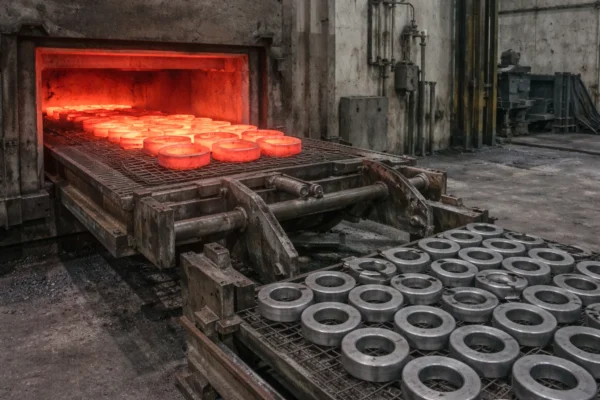
| 7 | Heat treatment | We adjust mechanical properties as required |
| 8 | Shot blasting and grinding | We clean surfaces and remove gates and risers |
| 9 | CNC machining and finishing | We machine faces, bores, and threads |
| 10 | Pressure test, NDT, and packing | We test, mark, and pack for export |
If your assembly also uses stamping parts, welding parts, or plastic parts, our wider group can support the whole set. One engineering team then checks the interactions between processes, not only single parts.
How do you evaluate a pump casting supplier or valve body casting manufacturer?
I know many RFQs go to ten or more suppliers. The lowest unit price often wins the first sample order. Later you see poor pressure test results, weak communication, or missing documents. Changing suppliers in the middle of a platform can hurt both profit and customer trust.
You should evaluate each pump casting supplier and valve body casting manufacturer on quality systems, technical capacity, machining and NDT capability, documentation strength, and delivery history. Strong partners follow ISO 9001, support PPAP, run in-house pressure and NDT tests, and manage export packing with care. They speak openly about process limits and work on long-term cost reduction with you.

What should your supplier scorecard include?
Here is a simple matrix you can use in vendor selection meetings. For more ideas, see industry overviews like Top 15 metal casting parts manufacturers in 2025.
| Area | Why it matters | What you should confirm |
|---|---|---|
| Quality system | Ensures stable castings and documents | ISO 9001 certificate and audit results |
| Technical know-how | Avoids trial and error on complex parts | Portfolio of pump and valve projects |
| Machining and finishing | Cuts extra suppliers and handling risk | CNC centers, fixtures, and process capability |
| NDT and pressure testing | Protects safety and warranty exposure | PT, RT, UT, and pressure benches |
| Documentation and PPAP | Supports OEM approvals and audits | Control plans, FMEA, PPAP examples |
| Communication | Speeds RFQs and solves issues fast | Response time and engineer access |
| Logistics and packing | Protects castings during transport | Export packing designs and forwarder network |
Your team can also watch neutral industry sources like Hydraulic Institute for pump standards and Valve Manufacturers Association of America for valve industry insights when you define these criteria.
Which cost drivers sit beyond unit price?
Unit price is important, but real cost often hides in scrap, rework, and time.
| Cost factor | Impact on your budget | How I usually help buyers |
|---|---|---|
| Tooling and development | One-time cost spread over volumes | Stage payments and clear tooling life planning |
| Alloy choice | Changes metal cost and machinability | Safe but economical alternatives |
| Tolerance and machining | Tight tolerances raise machining time | Balance between casting precision and CNC work |
| NDT and inspection level | Adds cost but lowers failure risk | Align with part criticality |
| Packing and logistics | Affects damage rate and freight cost | Optimized pallet loads and packing layouts |
This approach lets you compare suppliers on total cost of ownership, not only on the first line of a quotation.
How do we mitigate your supply chain risks as your casting partner?
Every purchasing manager thinks about risk at least as much as price. You worry about alloy supply, tool damage, sudden demand peaks, and shipping issues. A good partner must think about these topics before they hit you.
At Prime we mitigate your supply chain risks through dual tooling strategies, preventive maintenance, strategic raw material stock, and clear escalation plans. We use pilot runs, PPAP style approvals, and robust packing concepts to protect both launch and serial supply. This way your team gains not only a price point but also a realistic safety net. For a broader China view, see our guide on China investment casting and risk mitigation.

What concrete actions reduce your risk?
Here is how we usually build a risk management picture for pump and valve projects:
| Risk area | Typical risk | Our mitigation approach |
|---|---|---|
| Tooling | Damage, wear, or late changes | Preventive maintenance, backup inserts |
| Material supply | Alloy price spikes, lead time swings | Strategic stock for key alloys |
| Process stability | Scrap spikes, test failures | SPC on critical features, 8D problem solving |
| Launch and ramp-up | Hidden issues after SOP | Pilot runs, PPAP style approvals |
| Logistics and packing | Damage, delays, customs issues | Export grade packing and forwarder network |
When you share forecast and lifetime volume, we plan tool life and capacity around that. For key projects we also define an emergency plan together: who acts, how fast, and which backup options exist.
Case study: how did we cut leakage for a stainless valve body OEM?
A European OEM once called me with a simple but painful message. Their current supplier delivered CF8M valve body castings with very high pressure test failure. Leakage rates reached 8–10%, and rework consumed days. Their team started to doubt all China supply, not just one foundry.
We redesigned the gating system, smoothed wall transitions, and added 100% pressure tests plus dye penetrant inspection on sealing faces. Within two sample rounds, all investment casting valve components passed pressure tests without leakage. The leakage rate dropped below 0.5%, and internal rework time fell by more than half.

What changed for the OEM in real numbers?
The medium was corrosive, so the drawing used CF8M per ASTM A351 for pressure containing parts.(alloycasting.com) They needed about 12,000 valve bodies per year in several sizes and also required documented control.
| Item | Before switching supplier | After moving to Prime |
|---|---|---|
| Leakage rate at pressure test | Around 8–10% of parts | Under 0.5% across many batches |
| Rework time per batch | One to two extra days | Less than half a day |
| Delivery reliability | Frequent delays of one to two weeks | Over 95% on time |
| Documentation | Incomplete and inconsistent | Full ITP, NDT, and pressure test reports |
| PPAP support | Not available | Level 3 style PPAP package |
Their quality manager later told me that heat marking and label clarity saved hours each month in the warehouse. These small details do not show in unit price, but they influence your daily workload and stress.
How can you start an investment casting pump/valve project with Prime today?
You may feel ready to test a new supplier, but you still worry about risk and workload. Your line already runs hard. You cannot afford confusion or extra coordination.
To start an investment casting project for pump components or valve components with Prime, you only need to send drawings, target materials, and annual volume. My team will prepare a DFM review, a detailed quotation, and a clear inspection plan. After you approve samples, pressure test results, and any PPAP documents, we lock a stable delivery plan around your forecast. If you want a more detailed RFQ guide, see how to get faster, more accurate quotes for investment casting parts.
You can send files directly through our contact page or by using the RFQ upload form. I personally review each new pump and valve project together with our engineers and quality team.
What should you include in your RFQ package?
Here is a compact RFQ checklist that speeds up quotation and avoids back-and-forth mail:
| Required information | Why it matters for quotation |
|---|---|
| 2D and 3D drawings | Define geometry, tolerances, and machining |
| Material grade and standard | Set alloy, heat treatment, and NDT level |
| Working pressure and medium | Guide material choice and pressure test rules |
| Annual volume and release plan | Help select tooling concept and price level |
| Quality documents needed | Prepare ITP, certificates, and PPAP options |

We also combine investment castings with fasteners and other machined components in many shipments. This supports traders and OEMs that want fewer suppliers and simpler customs work.
FAQs about investment casting pump and valve components
What information do you need to quote investment casting pump components?
I need 2D drawings, 3D models if possible, the material grade, and annual volume. I also need working pressure, fluid, and any special standards. With this information I can design tooling, choose the right shell system, and prepare a realistic offer.
What is a typical lead time from a pump casting supplier in China?
Tooling and first samples usually take about four to six weeks, depending on complexity. After sample approval, regular batches often ship in four to five weeks. Exact timing depends on alloy, NDT level, and quantity, and I always share a clear schedule before you place orders.
How do you control leakage risk for valve body casting projects?
We design feeding to avoid shrinkage in thick sections and we keep proper radii in corners. We run 100% pressure tests on valve bodies and often add dye penetrant tests on sealing faces. This combination catches weak parts before shipment and keeps your leakage risk very low.
Can you support PPAP for pump and valve components?
Yes, we support PPAP style packages when your customer requires them. We include dimensional reports, material certificates, process flow diagrams, control plans, and sometimes capability studies. Your quality team can then use this file during customer audits and approvals.
Which NDT methods do you use for safety critical valve components?
For surface cracks we use dye penetrant testing around sealing faces and flanges. For internal defects we use radiographic or ultrasonic testing, based on wall thickness and design risk. Each part and each zone receives the most suitable inspection method.
Which materials do you recommend for seawater pump casting components?
For seawater I usually suggest duplex or super duplex stainless steel. These alloys resist chloride attack better than standard stainless grades like 316. They deliver longer life and more stable performance for casings, impellers, and valve trim in desalination or marine systems. For more background you can review duplex stainless steel guidance from major producers.
What minimum annual volume do you accept for valve components?
We support development projects from a few hundred pieces per year, but tooling cost will then have more weight. For long-term programs, yearly volumes above 2,000 pieces per size usually give better cost balance. When you share forecast and lifetime volume, I can match tooling and pricing to your plan.
Can you deliver machined and fully packed investment casting valve components?
Yes, Prime runs CNC machining lines and export packing in the same group. We deliver ready-to-assemble valve bodies and pump casings with markings, pressure test reports, and customized pallets. You save time, reduce transport risk, and work with one responsible partner.

Below are example authority domains that many pump and valve buyers watch. You can use them for technical references, internal training, and industry benchmarking. They are not linked to Prime; you should review them yourself before any cooperation.
| Topic | Example domains (non-affiliated) |
|---|---|
| Global standards | iso.org, ansi.org |
| Quality management | asq.org, quality-one.com, nsf.org |
| Pump standards and guides | pumps.org, europump.net, aft.com/hi-standards |
| Valve industry insights | vma.org, valvemagazine.com, vmaevents.org |
| Metal casting technology | afsinc.org, sme.org, castingdesign.org, foundrymag.com |
| Engineering data | matweb.com, engineeringtoolbox.com, steel.org |
Conclusion
Share your pump and valve drawings and yearly volume with Prime today for stable investment castings, ISO control, and fast, reliable delivery.
➡ Upload RFQ / Contact Prime »